


The iron rood screen was donated by Miss Middleton of London, (the same donor who provided the Stations of the Cross), on the Christmas of 1886. It was made by Hardman, Powell & Co. in Birmingham. The gold lettering in wrought iron reads: “Per mortem tuam libera nos Domine” (By thy death deliver us, O Lord). The scene, as in the stain glass, shows the Crucifixion with the Virgin Mary and the beloved disciple (St John) at His feet.
Mary and St. John at the foot of the cross represent profound faith, compassion, and sorrow. Mary, Jesus’ mother, stands as the sorrowful yet steadfast mother, embodying love and sacrifice. St. John, the beloved disciple, symbolizes faithful discipleship and care. Together, they witness Christ’s suffering, reminding us of loyalty, courage, and the power of compassionate presence in times of pain.
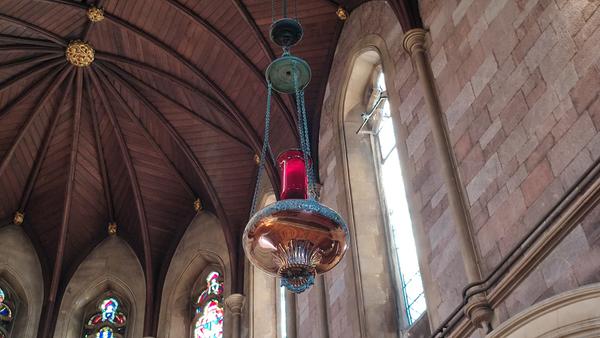
Sanctuary lamp. The sanctuary lamp is a continuously burning light placed near the tabernacle, symbolizing the real presence of Jesus Christ in the Eucharist.
The original High Altar was fronted with Beer stone, matching the reredos, and depicted three of the Seven Sacraments, (the other four are shown on either side on the reredos). Neither the altar nor the reredos was complete at the time of the church’s opening on 18th November 1884. These were completed and the alabaster tabernacle, designed by Rev. Alexander Scoles of Bridgewater, installed on the Feast of Pentecost 1887.


The carvings on either side of the sanctuary four of the seven Sacraments: Confirmation, the Eucharist, the Anointing of the Sick and Holy Orders. The other three Sacraments, Baptism, Reconciliation and Holy Matrimony were depicted on the original High Altar.
On the far left side of the altar, the stone reredos depicts St John Fisher (dressed as a Cardinal, holding an axe) and St Peter (with keys), while the panel between them shows the miracle of loaves and fishes.
Saint John Fisher was a 16th-century English bishop, scholar, and martyr. As Bishop of Rochester, he strongly defended the Catholic Church’s authority and opposed King Henry VIII’s separation from Rome. Fisher refused to accept the king as the head of the Church of England, leading to his imprisonment and execution in 1535. He is remembered for his courage, intellectual rigor, and steadfast faith, and was canonized in 1935.


The central-left panel of the altar reredos depicts the Adoration of the Holy Eucharist by saints and angels.

The central-right panel of the altar reredos depicts the Sacred Heart of Jesus, adored by saints and angels.


To the far right of the altar the reredos depicts St John the Evangelist to the left and St Cuthbert Mayne to the right. The panel between them represent the Manna from Heaven.
Saint Cuthbert Mayne was an English Catholic priest and martyr during the Reformation. Born in 1544, he was the first seminary priest executed under Elizabeth I for secretly celebrating Mass and spreading Catholic faith. Arrested and executed in 1577, he is remembered for his courage and steadfast commitment to his beliefs despite persecution. Canonized in 1970, Saint Cuthbert Mayne symbolizes religious conviction and sacrifice during a time of intense religious conflict.

The throne above the High Altar was used during Exposition of the Blessed Sacrament. The Monstance containing the Host would be placed there so as to be clearly visible. These days it is placed instead on the altar.
The church escaped serious damage during the air-raids on Exeter in May 1942, with only minor damage to the roof and with the main doors badly scorched by the heat. However, probably due to structural weakening sustained at this time, the stone parapet over the porch suddenly fell off one Sunday morning during the 9:30am Mass (Sunday 29th July 1956), due to a fierce gale during a storm. In thanksgiving that nobody was hurt, a new monstrance was presented to the church on Sunday 15th of June 1958.

The Tabernacle is made of alabaster and marble, designed by the Rev. Alexander Scoles of Bridgwater. The Tabernacle is the place where the Blessed Sacrament is kept safe in the church, it is the holiest place as it contains the Body of Christ, the real presence of God.

Mural depicting James Turberville, last Catholic Bishop of Exeter, celebrating mass at the moment of the consecration.
The golden lettering of the top says: “In the mass there is offered the true body and blood of Christ” “A propitiatory sacrifice for the living and the dead”. While the lettering at the bottom expresses: “James Turberville Last Catholic Bishop of Exeter” “Deposed by Queen Elizabeth 1559 & Died in prison November . 1. 1570”.
It was placed in the Sanctuary on the 20th of November 1906.
After the failure of the Western Rising to defend the faith and it continued to be practiced in secret, but in 1558 with the ascension of Elizabeth I Catholicism was made illegal. She dissolved the Episcopate of Queen Mary’s reign, and Bishop Turverbille, along with others who opposed the Acts of Uniformity and Supremacy, was imprisoned in the Tower of London in 1560. Three years later he was released to live under house arrest until he died in 1570.

Mural depicting Christ the High Priest, holding the consecrated bread and wine. On the top can be read in golden lettering: “Tu es sacerdos in aeternum secundum ordinem melchisedech. ps. 100” (You are a priest forever, according to the order of Melchizedek. Psalm 110:4).
It was placed in the Sanctuary on the 20th of November 1906. Jesus is described as a priest “forever in the order of Melchizedek” to emphasize His eternal, perfect priesthood that surpasses the temporary Levitical priesthood.
This means Jesus is the ultimate mediator between God and humanity, offering a once-and-for-all sacrifice for sins.
