
ST SIDWELL
The virgin St Sidwell, also known as Sidwella or Sativola, was the sister of Juthwara is the patron saint of Exeter. Her feast is celebrated on 2nd August.
According to legend, when her father, a wealthy landowner, died, her stepmother, jealous of her beauty and virtue, hired two men to kill her so she could keep the inheritance. She was beheaded with a scythe, and where her head fell, water sprang up from the spot, and a shaft of light shone out for three nights.
She was buried in St Sidwells, east of the Exeter city centre, while the spring became the Well of St Sidwell and was a place of pilgrimage.
Exeter city dedicated one church and a main street to her, while the village of Laneast in Cornwall also has a dedicated church with a well. She is also depicted in a stained glass window in Exeter Cathedral. She is represented with a scythe and a well.
Prayer for martyrs:
Lord, so great is our love for you, that even though we walk in a world where speaking your name can mean certain death, your faithful still speak it, and speak it all the louder.
Help us work for a world where all may speak their creeds, and pray their prayers, without fear of violence.
Hear the prayers of those who abide with you, in dangerous times, and in dark valleys, and who die with your name on their lips. Draw them quickly to your side, where they might know eternal peace. Amen.

ST JUTHWARA
Also known as Jutwara or Juthware.
A virgin from probably the eight century surrounded in legend. Her feast is celebrated on the 28th November, the date of her martyrdom, but in some places she is celebrated on 13th July, the anniversary of the translation of her relics.
According to the story of her life written in the fourteenth century she grew up in Dorset, the sister of St Sidwell, and was very pious from an early age. According to legend, her murder was engineered by her scheming stepmother. Broken-hearted at the death of her father, the girl complained of pains in her chest. Her stepmother recommended she apply soft cheeses to her chest as a remedy, meanwhile telling her son Bana that his sister was pregnant. Interpreting the wet patches on her clothing as proof of pregnancy, he struck off her head, but a spring of water appeared at the spot, and the girl picked up her head and carried it to the church. Bana repented of his crime, became a monk and founded the monastery of Gerber.
Her body was translated to Sherborne Abbey in the eleventh century, where her shrine was a place of pilgrimage until the Reformation. She is still depicted in the window of the Abbey and in many altars in Devon.
Request the priest Wulfric, to Bishop Aelwold of Sherborne:
“Ask the brethren to dip the relics of St. Juthwara, who was translated thither by Bishop Aelfwold, into some water, and to send it to me to drink. For I believe that I shall receive life and my former health through it.”

ST LIOBA
Also known as Leoba and Leofgyth. She was born c.710 in Wessex and died in 782 in Schornsheim, Germany. Her feast is on the 28th September.
She was the only child of a noble family, and a relative of St Boniface. Before being conceived, her mother dreamed that she would lead a spiritual life. She entered the double monastery of Wimborne Minster, and became famous for her skills in copying and ornamenting manuscripts.
St Boniface asked her to help him in his evangelisation of Germany, and she became as a wise teacher and a great counselor. She later would be consulted by bishops and was favoured in the royal court of Charlemagne.
She became the abbess of a convent established by Boniface, and was his delegate while he was away in Frisia. Boniface even wanted her to be buried in his tomb, but she was eventually buried in a nearby tomb.
She reportedly performed many miracles, such as saving a village from a fire through her prayer, and saving the life of a fellow nun who was gravely ill. Her grave also became renowned as the site of many miracles, and the miracles.
Poem by St Lioba from a letter to St Boniface:
Farewell, and may you live long and happily, making intercession for me.
The omnipotent Ruler who alone created everything,
He who shines in splendour forever in His Father's kingdom,
The perpetual fire by which the glory of Christ reigns,
May preserve you forever in perennial right.

ST EORAN
Also known as Oran, Odran or Odhran of Iona. By tradition a descendant of the Irish king Conall Gulban, and the first Christian to be buried on Iona.
He died in 548 AD, and his feast is celebrated on the 27th October.
He built a church in Silvermines in Ireland, served as an abbot in Meath, and founded the monastery at Lattreagh. He was among the twelve that accompanied St Columba to the isle of Iona.
His death on Iona is surrounded in myth. It is said that St Columba saw devils and angels fighting over his soul as it went up to heaven. Other legends claim Columba that heard a voice saying that a chapel could not be built on Iona unless a living man was buried below, so St Eoran accepted to be buried as a sacrifice.
Prayer from The Roman Missal:
O God, who in your kindness called your servant blessed Eoran to the following of Christ, grant, we pray, through his intercession, that, denying ourselves, we may hold fast to you with all our heart. Through our Lord Jesus Christ, your Son, who lives and reigns with you in the unity of the Holy Spirit, one God, for ever and ever. Amen.

ST WINNIBALD
Also known as Winebald, Winnibald, Wunebald or Wynbald. Brother of St Willibald and St Walburga, and son of St Richard the Saxon.
He lived from 702 to the 18th December 761. He is a patron saint of construction workers.
He made a pilgrimage to the Holy Land with his brother Willibald and father Richard, but his father died en route in Lucca, Italy, while he himself fell ill, remaining in Rome to recover and study while his brother continued to the Holy Land.
He travelled from England to Rome a second time to start a monastic life and was recruited with his brother to help in the evangelization of Germany. He was ordained and settled in Eichstätt, with the care of seven churches.
He established a monastery in Schwanfeld, and when he was transferred to Heidenheim he founded a double Benedictine monastery with his brother, a center of learning and for the training of priests, where he became the first abbot.
Despite his poor health, he took part in the Concilium Germanicum, the first major church synod of the eastern Frankish kingdoms, presided over by St Boniface.

ST WALBURGA
Also known as Walpurga, Wealdburg, Valpurga, Walpurgis or Valborg.
She was born in Devon in 710 AD, the sister of St Willibald and St Winibald. She died on 25th February either in 777 or 779 AD.
While her father and brothers travelled she remained in Wimborne Abbey in Dorset, where she was educated and became a nun. The nuns of the Abbey were skilled in copying and ornamenting manuscripts, highly demanded in all Europe.
When her uncle St Boniface recruited her brothers for his mission in Germany, she travelled with them to assist in the evangelisation. There she joined the double monastery founded by St Willibald, and after his death she became Abbess. After the death of St Winnibald she also succeeded him as superintendent of the entire Abbey.
She was buried in the Abbey of Heidenheim, but translated to Eichstätt (Bavaria) in 870 AD, on the 1st May. The eve of her translation feast day is known as Saint Walpurgis Night.
Miracles attributed to her include calming a tempest with her prayers. Her tomb in Eichstätt is said to have exuded a therapeutic oil that drew many pilgrims. She is the patroness of various cities in Germany, Belgium and the Netherlands. She is also a patroness against rabies, and against storms at sea.
Prayer to St Walburga:
I joyfully salute you today, O royal virgin, and I thank you especially for that great love with which, together with your brothers Willibald and Winnibald, you did bring the light of faith to our ancestors.
O holy virgin, by your great merits, I pray and beseech you to enlighten me by your example, and help me by your powerful patronage, that I may be delivered from every sinful inclination and inordinate attachment to creatures and to myself, and that I may wholly and entirely lose myself in God.
Your heroic courage in despising earthly goods encourages and helps me to sever once and for all those ties which still bind me to the world and its pleasures.
May your burning love for souls deliver me from all luke-warmness, so that I may die to the world and strive after Heaven.
Amen.

ST GREGORY III
The 90th pope; born in Syria he was the last non-European pope until the election of Pope Francis in 2013. He became bishop of Rome in 731 AD and died on 28th November 741. His feast day is celebrated on the 10th December.
He tried to moderate the iconoclasm of Emperor Leo III. Gregory defended the veneration of icons and relics, and repaired and beautified numerous churches. He erected a wall of icons and an oratory full of relics in the Basilica of St Peter.
He was a great supporter of monasticism, established the monastery of St Chrysogonus and rebuilt a hospice in Rome. He also dealt with longstanding internal disputes, promoted the Church in northern Europe, and supported the mission of St Boniface in Germany. He made St Boniface archbishop of Germany in 732 AD and papal nuncio.
He banned the consumption of horse meat for its association with pagan rituals in 732 AD.
He addressed the Lombard threat in Italy by completing the restoration of the Aurelian Walls, and refortifying the city of Centumcellae. He died before the Lombard advance was halted, and he was buried in the oratory he had built in the Basilica of St Peter.
Quote from Pope St Gregory III:
“May the Lord preserve the faith of His Church, that His truth may shine brightly in all hearts.”
Prayer to Pope St Gregory III:
Almighty and eternal God, You willed to set St. Gregory over Your entire people and to go before them in word and example. By his intercession keep the pastors of Your Church together with their flocks and guide them in the way of eternal salvation.
Amen.

ST BURCHARD
Also known as Burchard of Würzburg. He died in the year 752 AD and his feast is celebrated on the 14th of October.
He was an Anglo-Saxon Benedictine monk who joined St Boniface as a missionary in Germany. He may also have been related to St Boniface.
He lived in the Abbey founded by St Boniface in Fritzlar, and later traveled to spread the gospel in Thuringia. He was appointed as bishop by St Boniface, approved by Carloman (of the Carolingian dynasty), and confirmed by Pope Zachary in 743 AD.
He was a member of the first German Council, attended the general Council of the Franks, and acted as an envoy to Rome for St Boniface. The year before his death he resigned and retired to solitude, and in his last year he translated the relics of Ss Kilian, Totnan and Colman to the Würzburg Cathedral, and he also dedicated the Abbey of St. Andrews in the same city, which was later rededicated as St. Burchard’s Abbey and is where his relics have rested since 986 AD.
Prayer for bishops:
God, eternal shepherd, you tend your Church in many ways and rule us with love. You have chosen N. to be your servant, to be a shepherd of your flock. Give him a spirit of courage and right judgment, a spirit of knowledge and love. By governing with fidelity those entrusted to his care, may he build your Church as a sign of salvation for the world.
Amen.

ST LULLUS
Also known as Lull or Lul. He lived from 710 to the 16th October 786.
Born in Wessex, he was first a Benedictine monk in Wiltshire. While on a pilgrimage to Rome in 737 he met St Boniface and accompanied him in his mission to Germany. There he joined the Benedictine monastery St Boniface had founded, under the abbot St Wigbert, who was also from England.
He became a close associate of St Boniface during the most important year of his work. He went to Rome twice on behalf of the saint and was included in the secret negotiations for his successor at Mainz. He also exchanged letters with St Edburga and St Leoba.
He was appointed bishop and later archbishop of Main, succeeding Boniface. Pope Adrian I granted him the pallium as a mark of special favour.He completed St Boniface’s reform of the church in the Carolingian empire, and concluded the christianisation of Hesse-Thuringia, working in close partnership with the Frankish kings.
He is one of the patrons of Hersfeld Abbey, where he was buried, and he is celebrated in Bad Hersfeld every year on Lullusfest, the oldest folk festival in Germany.
German prayer for St Lullus intercession:
Lord. You chose Saint Lullus as Archbishop of Mainz. Bless our Bishop and all bishops who care for the well-being of the Church.
Saint Lullus dedicated his whole life to proclaiming the Good News of Jesus Christ to people. Make your Gospel a way into people's hearts today too.
Lullus promoted faith by reorganizing the Church in the Frankish Empire. Revive the expectation of your kingdom in Christians and help them to live according to your word.
Saint Lullus founded the Benedictine monasteries of Bleidenstadt and Hersfeld. Grant the religious who live according to the Rule of Saint Benedict the grace to find fulfillment in their lives in you.We trust in your help through the intercession of Saint Lullus, so that we may preserve the faith he once preached. Through Christ our Lord.
Amen.

ST WILLIHAD
Also known as Willehad. He lived from 745 to the 8th November of 789.
Born in Northumbria and probably educated at York, he continued the missionary work of St Boniface after he was martyred, in charge of one of the missionary zones of Saxony (Wigmodia).
Charlemagne sent him to preach in the area of the Weser River. He faced strong opposition and was forced to escape to Utrecht. He was then sent once more by Charlemagne to evangelise the Saxons, but had to escape again two years later to Frisia. He returned to Rome to report to Pope Adrian I on his work and retired for a time to a monastery in present-day Luxembourg.
After Charlemagne’s conquest of the Saxons he continued preaching and was consecrated bishop for the region around the mouth of the Weser, building a cathedral in the city of Bremen and a small church at Blexen.He was buried in the cathedral he consecrated shortly before his death.
Prayer to St Willihad:
Oh Saint Willehad, we ask for your intercession as we strive to spread the Gospel as fervently as you did. Inspire us to be steadfast in our faith, and give us the courage to share the love and hope of Christ with others.
Amen.

ST WILLIBALD
Born in Wessex c.700 and died in Bavaria in 787, where he was bishop of Eichstätt. He was the son of St Richard and the brother of Ss Winnibald and Walburga. His feast is celebrated on 9th July.
He was well-traveled being the first known Englishman to visit Holy Land, and played a key role spreading Christianity in a time when Europe was living through cultural and religious change.
He is the patron saint of travelers, pilgrims and people seeking safe journeys.
At the age of three he came close to dying from a serious illness. His parents vowed to dedicate him to a monastic life if he survived, and he duly lived. He entered a Benedictine monastery at the age of five, where he lived the monastic ideal of being a pilgrim for Christ, having no true home on earth.
Other traditions have him embarking on the pilgrimage to the Holy Land with his father Richard and brother Winnibald, only for his father to die en route in Lucca.
After many travels, the Pope allowed him to assist Saint Boniface in his missions in Germany. He started his mission in Eichstätt, where he became the bishop and later the patron saint of this city.
He lived in a monastery, where he received visitors from all around Europe to listen about his journey and monasticism.
Prayer to St Willibald:
St Willibald, holy pilgrim and faithful missionary of Christ,guide our steps through life’s paths. Protect us in our travels and daily journeys, keep us safe from all visible and unseen dangers, and strengthen our faith in every direction we take. May our lives, like yours, be a journey of love, courage and service.
Amen.

ST RICHARD
Also known as Richard the pilgrim or Richard of Wessex.
Richard (d. c. 720) was an Anglo-Saxon nobleman, the husband of St Wuna and father of Ss Willibald, Winnibald, and Walburga. He died in Lucca in Italy while leading his family on a pilgrimage to the Holy Land. His feast is celebrated on 7th February.
He is said to have secured the miraculous healing, through his prayers, of his son Willibald when the child lay dying from a serious illness.
Entrusting his daughter Walburga to the Abbess of Wimborne, he embarked on his pilgrimage with his two sons, but was taken ill in Lucca and died there. He was buried in the church of San Frediano, and a cult soon grew up around him as miracles were reported around his tomb.
The name Richard (not a Saxon name), was probably attributed to him by the people of Lucca, and his real name is not recorded. He came to be described as a king of the Anglo-Saxons, although this was not the case, and he is traditionally depicted with a crown at his feet, representing his renunciation of his title and lands.
Some of his relics were translated to the cathedral in Eichstätt, Germany, were he is venerated to this day.
His three children would all go on to become important figures in the Church. Willibald became the bishop of Eichstätt, Winnibald the Abbot of Heidenheim, and Walburga the Abbess of Heidenheim, and all three came to be venerated as saints.
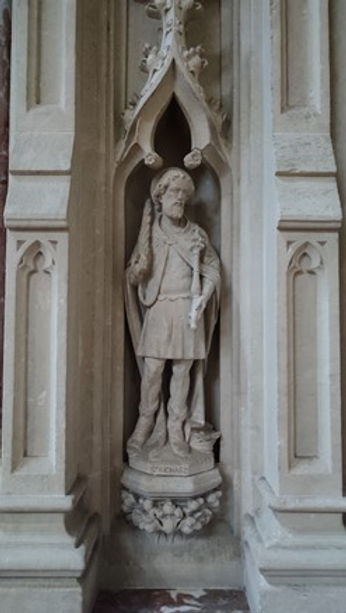
POPE ST GREGORY II
Also known to his contemporaries as Gregory Junior or the Younger.
The 89th Pope. Born in 669 and Pope from 715 until his death in 731 on the 11th February, when his feast is celebrated.
One of the greatest Popes of the 8th century. He is the first person known by name to have been in charge of the papal library. As soon as he became deacon, his intelligence and character led to him being chosen by Pope Constantine to accompany him to Constantinople for negotiations with the Emperor Justinian II.
As Pope he started repairing the walls of Rome, received many distinguished pilgrims, and he dispatched apostles for the conversion of Bavaria, like St Boniface. Gregory oversaw and encouraged the work of St Boniface unwaveringly, consecrating him bishop in the year 722 AD.
He was a great supporter of the monastic life, converted his parental home into a monastery, and founded and restored many orders. He also opposed the Greek emperor Leo III in his iconoclasm, illegal taxes and interference in the ecclesiastical authority.
Prayer for the virtues of Pope St Gregory II:
God, we pray that the example of your faithful servant Pope Gregory II will inspire us to live a life rooted in love and humility. May we remain steadfast in our faith, just as he did amid trials and tribulations.
Amen.

ST WILLIBRORD
Also known as Willibrord of Utrecht (where he was the first bishop and built the cathedral) and Apostle to the Frisians.
Monk, bishop and missionary, born in Northumbria and died in Luxembourg (658 to 739 AD). Feast celebrated on 7th November.
He is the patron saint of convulsions, epilepsy, and epileptics. He is also the patron saint of Luxembourg and Netherlands, and the Archdiocese of Utrecht (Netherlands).
From childhood he was an oblate at Ripon Abbey (North Yorkshire), and later he spent 12 years with the Benedictines years in Ireland (a centre of European learning in that time).
He made two journeys to Rome, on the first occasion Pope Sergius I gave him the mission of preaching the Gospel to the Gentiles, and on the second he received the pallium and was consecrated as a bishop.
He established the Abbey of Echternach, but was forced to flee when the king of the Frisians, Radbod, retook possession of Frisia, burning churches and killing many missionaries. After his death, Willibrord repaired the damage, assisted by Saint Boniface.
Prayer of St Willibrord:
O God, the Saviour of all, who sent your bishop Willibrord as a pilgrim for Christ to proclaim the good news to many peoples and confirm them in their faith, help us also, we beseech you, to witness to your steadfast love by word and deed so that your Church may increase and grow strong in holiness. Through Christ our Lord. Amen.
